

Discovering the Beauty of the Semois
Saturday morning, nine o’clock. I am standing with a group of Dutch friends by the small church in Tintigny. They are already impressed. The drive here led us through one of Belgium’s most beautiful regions, the gently rolling Gaume, wrapped in morning mist, with sandstone farmhouses scattered across the landscape. A foretaste of what was to come. Three days of canoeing on the Semois.
I had lured them here with the promise of a wilderness experience on one of the finest rivers of the Low Countries. Skepticism was considerable at first, but the idea of a shared canoe trip prevailed. The Semois is a classic canoe river. She follows her natural course, without canalisation or straightening. The landscape along her banks is varied and rich, high cliffs, smooth gliding stretches, playful riffles, quiet camping spots, beech forests and villages crowned by medieval castles.

An Adventurous and Athletic Canoe Route
The Semois is ideally suited for multi-day canoe journeys. Between Chiny and Bohan she is navigable over 120 kilometres, depending on water levels. In autumn and winter an additional day can be added by starting in Tintigny. This upper section of 25 kilometres is only open from 1 October to 15 March. Together, this makes nearly 150 kilometres of uninterrupted navigation.
Most of the descent runs through protected natural areas. The current alternates between calm and lively, without major technical difficulties. Still, risks remain, especially at dams. Good paddling technique, proper equipment and careful preparation are essential. Knowing where obstacles are located is no luxury.

A River of Landscapes and Life
From her source near Arlon to her confluence with the Meuse in France, the Semois changes character several times. Over the first seventy kilometres she flows through the Lorraine plain. Further downstream she cuts deep into the Ardennes. At the French border she even changes her name, continuing as the Semoy until she joins the Meuse at Monthermé.
In the Ardennes, steep wooded slopes, marshy grasslands and deeply incised meanders follow one another. This diversity creates a rich mosaic of habitats. More than eighty percent of the valley is part of the Natura 2000 network. In summer, meadows bloom and hum with insects and birds. In winter, buzzards, peregrine falcons and hen harriers circle low above the fields. Along the banks, great egrets stand motionless. Kingfishers are numerous and often allow close observation. Ducks and swans are also active, their courtship rituals unfolding in rhythmic, focused movements, clearly visible from the canoe.
Life continues beneath the surface as well. Trout take advantage of periods of high water to spawn, selecting gravel and pebble beds in shallow, well-oxygenated sections of the river. They sometimes move into small tributaries. By rubbing their bodies against the gravel, they clear spawning beds where eggs and later young fish develop. These areas are extremely vulnerable. Paddling at sufficient water levels is therefore essential to avoid damage. Landing and stopping are only permitted at designated access points, clearly marked along the river.

From Tintigny to Chiny, Across the Gaume Plain
The launch site in Tintigny lies on the left bank just downstream of the bridge and is somewhat difficult to access. We park the cars a little further on. The first section to Termes, at eleven kilometres, is the longest of the day. Here the river is sometimes no more than five metres wide and winds endlessly through tight meanders. The landscape is open and quiet. The current is weak, but vigilance is required, a fallen tree can block the entire river.
At Termes we reach the first dam. It looks imposing, but can be safely run through the central passage. The opening on the left is a sluice and not navigable. At lower water levels, a carry is possible on the right bank.

Towards Jamoigne the landscape remains soft and open. A strong headwind rises. Thanks to the meanders we regularly find shelter from it. The dam at Jamoigne demands attention, the correct passage lies to the left, through a narrow and winding side channel. The right-hand side leads to the mill and is forbidden. We stop to scout on foot. One and a half kilometres downstream lies the landing place at Jamoigne.
Below Jamoigne the river slows, widened by the waters of the Vierre. Dusk sets in and we realise we will arrive after sunset. Entering the forest, darkness falls suddenly and the air becomes still. Beavers announce their presence by slapping their tails loudly on the water. We paddle on. In Chiny, at Camping Le Canada, camp is set up quickly. Within half an hour the fire is burning.

From Chiny to Chassepierre, Cliffs and Bends
We leave early. Another demanding day of 25 kilometres lies ahead. It is raining, but everyone is well equipped. We launch from the spacious access point with a jetty near the sandstone Saint-Nicolas Bridge. Just downstream lies a low weir. We scout the passage first, far left, unmarked, with several large stones immediately below.
At high water we run the dam easily, though the bow paddlers receive an immediate shower. The current quickens and carries us swiftly downstream. Soon after comes a second dam, again without a clearly marked passage. When water levels allow, it can be bypassed via a narrow channel on the left.
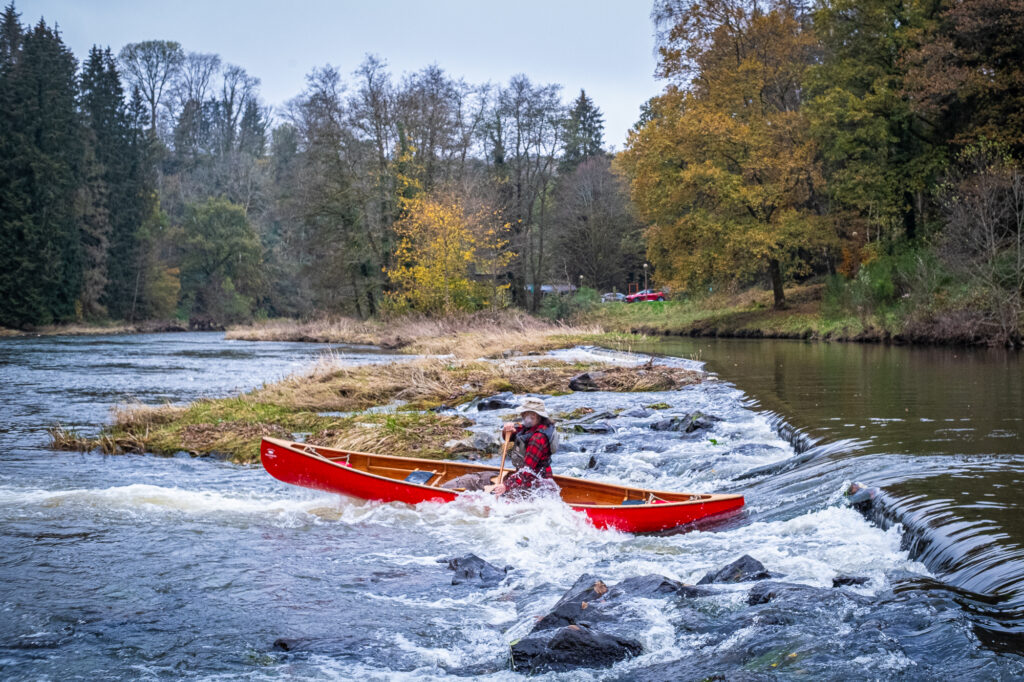
After four kilometres we reach the second landing place at Chiny. The river enters the forest, winding past rock faces with names such as Rocher Pinco and Le Hât. Near Lacuisine the current slackens and the river takes on the character of a long, narrow lake. After the Lacuisine dam, with its wide marked passage, the landscape opens again towards Florenville.
At Martué, remains of an old dam create a technical passage between small islands. Then follows a long forested stretch with many rocks and bends. Thanks to the high water level this becomes a playful and technical section. Leaving the forest, Chassepierre appears. Just after the bridge lies a large meadow for landing. We continue a little further to Camping Le Semois and pitch our tents by the water.

Through the Forest, From Chassepierre to Cugnon
Below Chassepierre the Semois flows northward, entirely through forest, all the way to the French border. Five kilometres downstream we carry around the Vanne des Moines dam. It can be run, but with heavily loaded boats we choose to portage. Another five kilometres on, we pass a reed bed filled with swans. Shortly after, the forest opens on the left to the grounds of the former Prieuré de Conques.
After another dam and the large railway bridge, we reach the Moulin Willaime. The passage is narrow, technical and difficult to read, followed immediately by a sharp right-hand bend. Great fun for experienced paddlers, less suitable for beginners. Carrying is possible on the right, close to the mill.
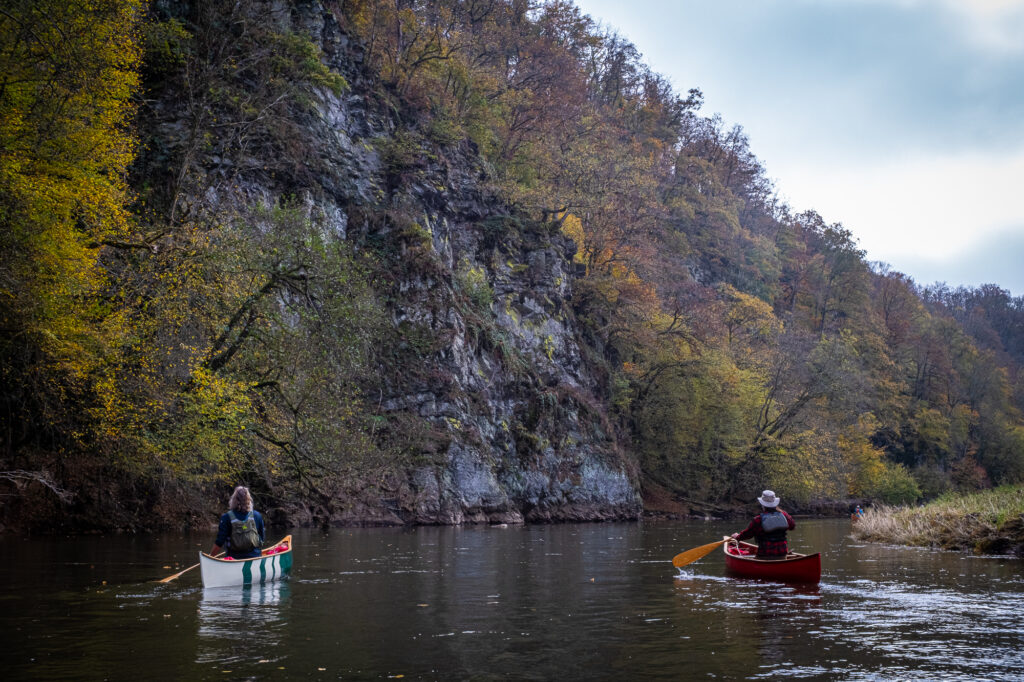
Further on lies the long meander of the Tombeau du Chevalier, with the castle of Herbeumont rising high above. Near the Plage des Nawés the current slows. The Nawés dam requires precision, with a sequence of narrow passages on the left-hand side.
From Pont de Linglé onwards, the Semois is considered legally navigable, a reminder of the time when tobacco and timber were transported along this river. We paddle another two kilometres to Moulin de Cugnon, run the final small dam on the left and bring our journey to a close.

A River That Stays With You
Three days on the Semois leave their mark. The river reveals herself in many guises, sometimes wide and calm, then narrow and lively. Bends follow one another, the landscape constantly changing. The act of paddling becomes simple, paddle, steer, observe. The days find a clear rhythm, shaped by light, current and distance. What remains is attention, for the water, for one another, for the place you are moving through.
The Semois offers space to step away from the cadence of daily life. Away from roads, schedules and screens. On the water, the distinction between effort and rest fades. You move with the river and realise how little is actually needed.

Respect for a Fragile Balance
This richness is not self-evident. The Semois carries great ecological value and is at the same time vulnerable. Human presence leaves traces, even when well intentioned. Sustainable recreation therefore means acting consciously, aware of place and timing. Following the rules is not a formality, but a way to limit impact, landing only at designated sites, respecting riverbanks, observing minimum water levels and avoiding disturbance of wildlife.
Paddling with attention deepens the experience. Those who slow down and observe, see more. Respect for the river enriches the journey and helps ensure that this place retains its character, not only for us, but also for those who come after.

A Testimony of Strength and Vulnerability
The Semois embodies the power of flowing water and the resilience of natural systems, but also their fragility. This three-day journey is more than a sporting adventure. It is a reminder of how closely landscape, water and life are intertwined, and of the responsibility we bear in caring for them.
What remains is gratitude. For the river, for the shared experience, for the simple joy of being on the way.
