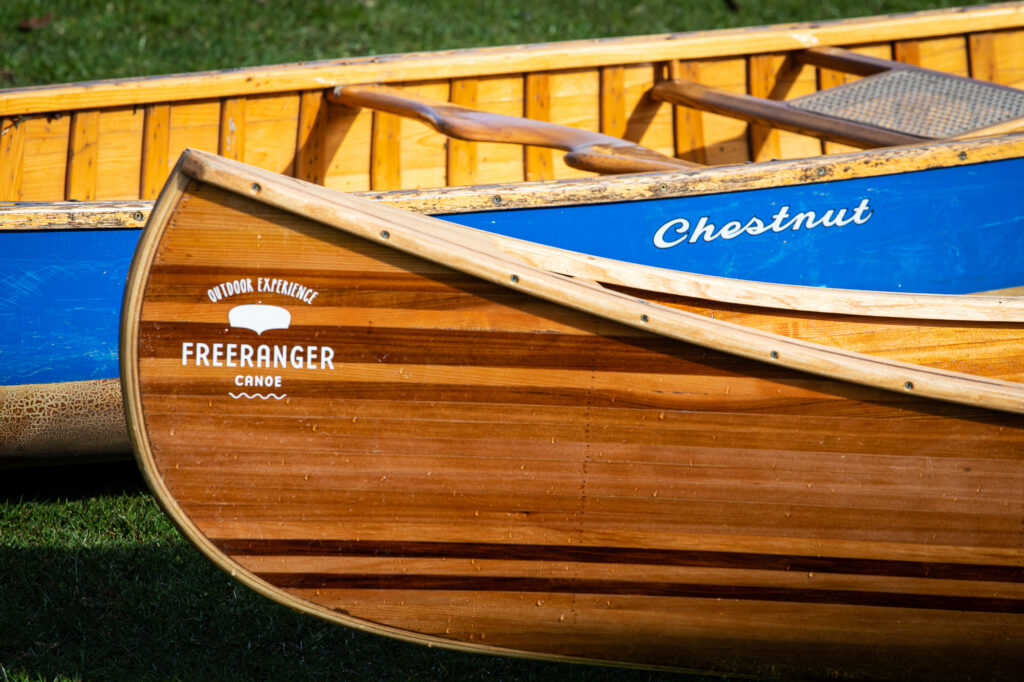
The Chum, a Living Form We Cherish
I can still see it clearly.
At the Open Canoe Festival in 2015, Frank Münker was paddling a Canadian Style kür. He was in a Millennium Sojourner, a limited canoe built and painted by Jerry Stelmok at Island Falls Canoe. It was not a performance, not a show. Just paddling. Canoe, paddler, paddle and water seemed to merge into a single, quiet movement. What stayed with me was not spectacle, but coherence. In that moment I understood that canoeing can be more than technique or transportation. It can be a form of attention.

Frank carries the classical Canadian canoe tradition within him. Not as something displayed, but as something embodied. We became friends and spoke often about paddling, about boats, about what a canoe should allow. A year later he brought his Chestnut Chum to my workshop with a simple question: would I build a faithful copy? In his words, it was the best solo canoe he knew. For me, it felt like trust, and responsibility.
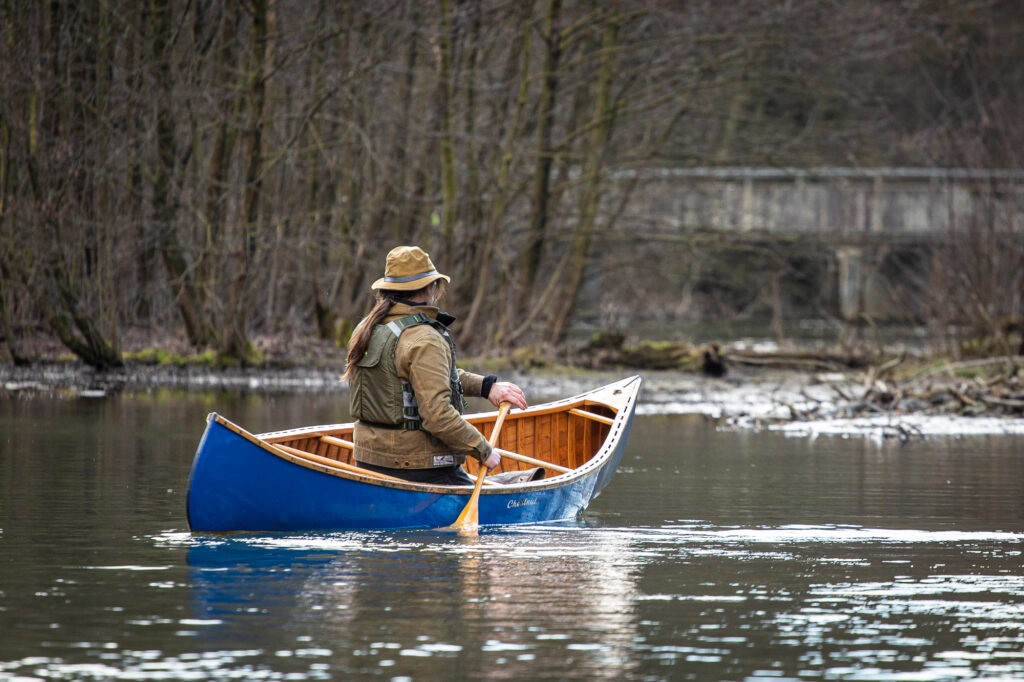
The Chum is a pleasure model from the Chestnut Canoe Company, a company that began building wood-canvas canoes in Fredericton, New Brunswick in the late nineteenth century. Chestnut canoes were not theoretical designs. They were shaped by use. Built for guides, travelers and recreational paddlers, tested on lakes and rivers, adjusted where necessary and refined over generations. Incorporated in 1907, the company rebuilt quickly after a devastating fire in 1921 and remained a defining name in Canadian canoe building for decades. Even through later mergers and restructuring, their distinctive character remained visible in subtle differences of hull shape, sheer line and detailing. In 1979 the last Chestnut canoes left the factory. The forms endured.

Originally marketed as a recreational tandem canoe, the fifteen-foot Chum sits perfectly between compact and capable. Today it is especially appreciated as a solo canoe, and that becomes obvious the moment you paddle it. Not too long, just wide enough, with sufficient volume to carry gear without compromising performance. Its softly rounded hull makes it easy to heel and surprisingly maneuverable without becoming nervous. It is a graceful, light-paddling canoe that leaves room for nuance and refinement.

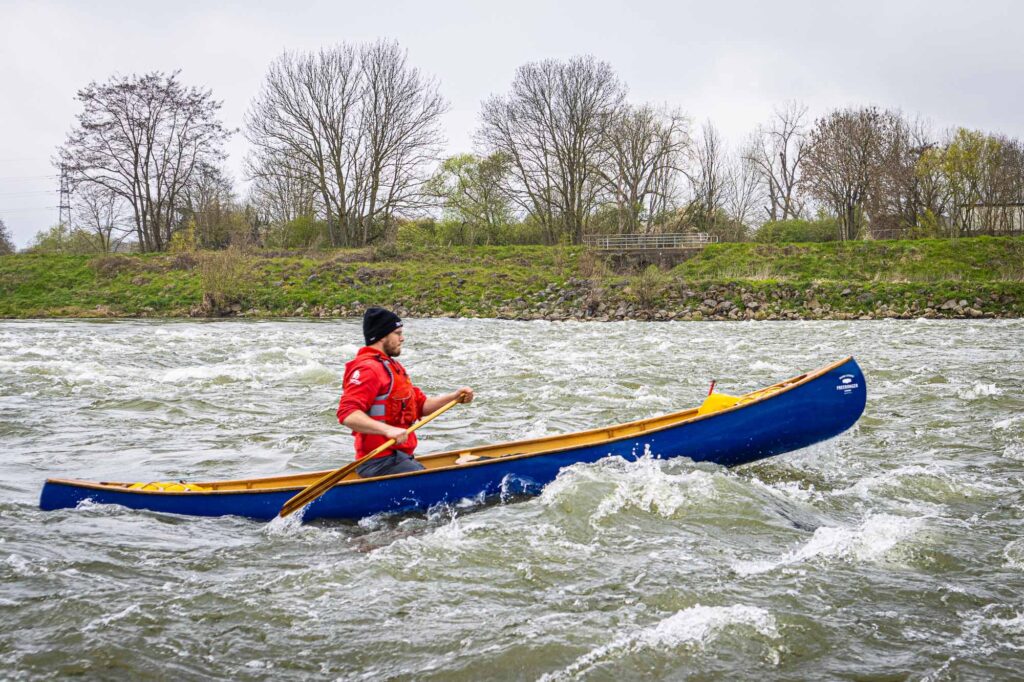
What makes the Chum particularly special to me is how naturally it performs on moving water and light whitewater. It is wonderfully responsive, entering and exiting eddies with little effort. The generous volume in the ends keeps it remarkably dry over small drops and in lively current. You feel that this canoe does not resist movement but works with it. It is equally at home on quiet lakes and on stretches where reading water, timing and precision matter. Calm and predictable, it invites you to refine your technique rather than overpower it.
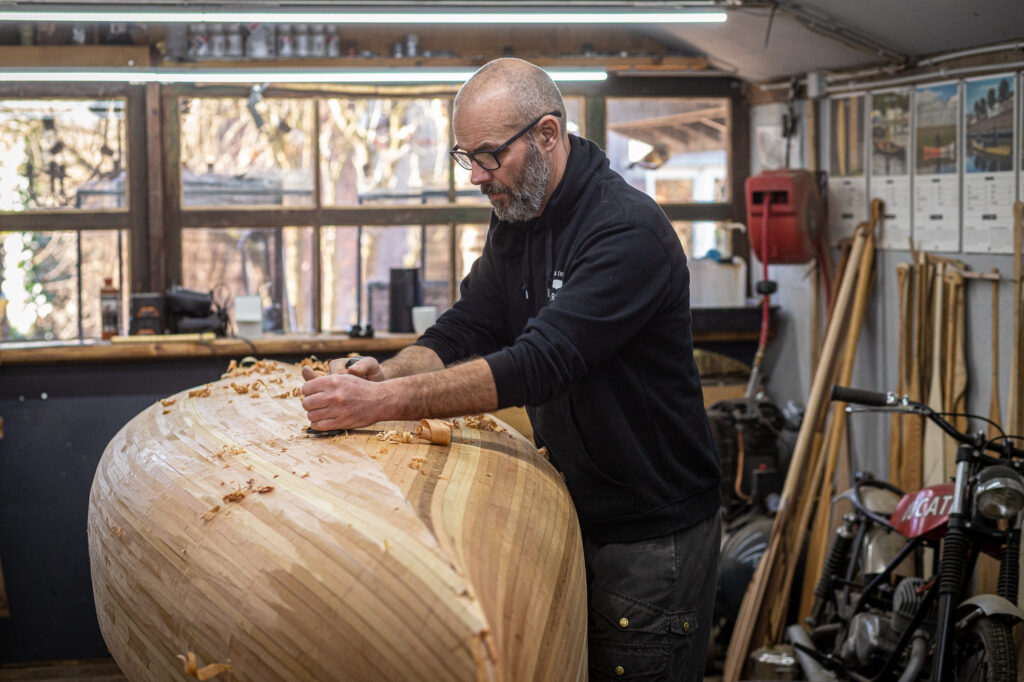
My role in this story is that of builder, but also of link. I do not build canoes to preserve shapes in isolation, but to make them function again. The first time I paddled a Chum, I knew this was no accidental design. The proportions, the balance, the behavior on the water, everything felt right. It is a canoe that rewards attentiveness.
This way of paddling belongs to a broader tradition. In Algonquin Park, Omer Stringer developed his distinctive solo style. As a young guide, often traveling alone in large canoes, he found an efficient and elegant way to control them: kneeling near the center, heeling the canoe deeply, allowing his body to move with the stroke. What began out of necessity evolved into a refined style in which canoe and paddler become one. Omer himself paddled a Chum. Not because it was unusual, but because its form lends itself naturally to this kind of paddling. A canoe that heels willingly, that combines volume with suppleness, and that allows movement without losing direction.

What I witnessed in Frank on the water belonged to that same lineage. And what I try to build into each Chum comes as close to that as I can make it. We carefully measured his canoe, not to improve it, but to understand it, to see why this shape works so well, and why it has done so for so long. Since then, for nearly ten years now, more than forty people have taken to the water in a Chum built in our workshop. That brings satisfaction. As confirmation of craftsmanship, certainly, but above all because a historical design is once again being used for what it was meant to do.
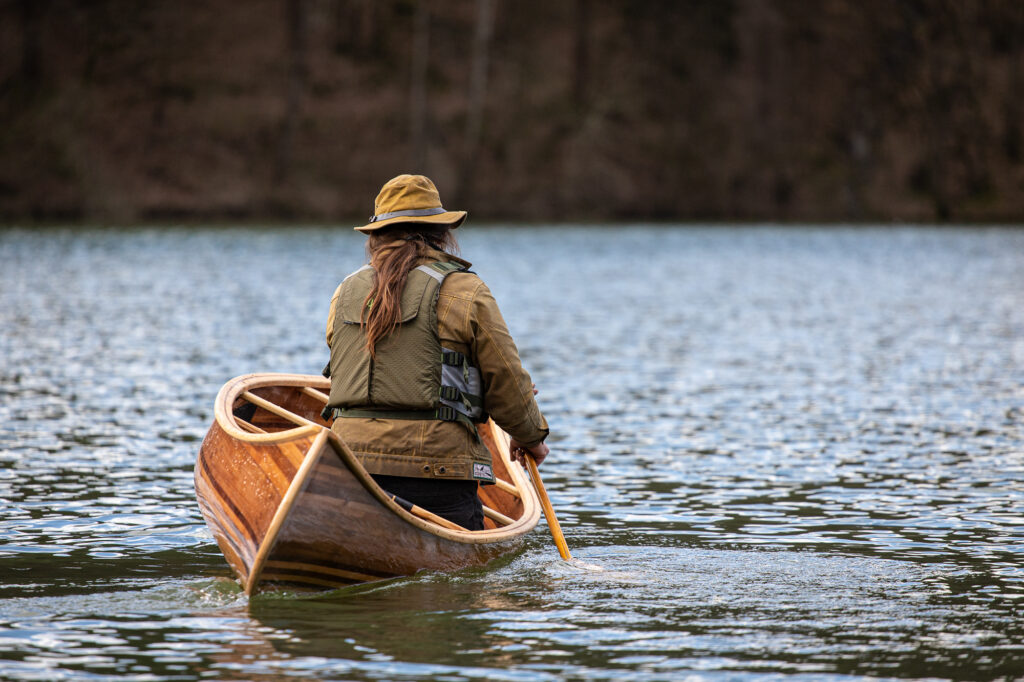
The Chum is not a nostalgic object. It is a living form, carried forward through a long line of building and paddling. From Chestnut to Stringer. From Stringer to Frank. And from there to me, and to everyone who takes it onto the water. Not as an endpoint, but as continuation.